

Tips and Tricks for New and even Old Travel Nurses!

Ok, do you wanna make the transition from staff to travel? Honestly anyone can do it, take that jump! When you are ready to take that jump, here are some great tips for new travel nurses and even old travel nurses.
- First off, you need to understand that transitioning from staff nursing to travel nursing is not gonna be easy or comfortable. No matter how long you’ve been a nurse or how outgoing you are, it’s not an easy transition. It makes you feel a little uncomfortable that you don’t know where anything is, anyone else, or any of the hospital policies right off the bat. Just know second-guessing leaving your staff job is a normal feeling. I remember moving from Maine to Washington state with my husband 42 hours away from home for my first travel assignment and thinking to myself was this the right decision. I even looked at him and said, “did we make the right choice?” Of course, he responded… “It’s a little late to question this decision, but yes this is the right decision.” I was worried about leaving my family, friends and my stable staff job, but I was ready for this adventure. My brother has four kids under four and that honestly made this decision so difficult for me. I love his kids more than anything… but I knew they would be there between contracts and after this adventure was done. I also remind new travelers that nursing is nursing. One year into travel nursing and I do not regret this decision. I have not been happier. It has been absolutely worth it.


- Do your research. There are a lot of Facebook groups. I started by reading opinions on Facebook groups. I asked people what companies to go with and what recruiters to go with. Shop around and hear what companies have to offer. I used to think you had to be loyal to one company and one recruiter. One year later and I have 4 companies and 4 recruiters. You also don’t need to be tolerable of people that are not willing to assist you. In other words, if the recruiter is not helpful, get a new recruiter. When I first started to look for my first travel assignment, I was looking with a recruiter that just seemed so busy. It took her a day to respond to my texts or emails and that didn’t work for me. I’d ask her to submit me for a job and she would respond 24 hours later that she went to submit me for a job and it was already full. I started getting a negative vibe with the company and that is not what I wanted. I ended up switching recruiters and I’ve had such a positive experience with the company now. I’m actually now on my third assignment with that company and recruiter! If you’re not pleased with the company or recruiter, make some changes. In terms of hospitals, don’t apply willy-nilly. Make sure to do your research on the hospital before you apply for a contract. When we apply for a contract, we research the hospital first to make sure it’d be a good fit. We look at the reviews of the hospital on google, we look at the reviews on Facebook of what other nurse travel nurses have said, and we also look at the location of the hospital. Nurses typically work 36 hours a week. (3 12 hour shifts), so the surrounding area is super important as they have 4 days to explore! Make sure to research the cost of living and availability of places to live. You want to make sure it compares to your pay. Groceries are also an important part of research. Nick and I always use the example when we moved to Spokane Washington. We walked into the grocery store and went to buy mandarin oranges and they were $8.99. We both looked at the sign with wide eyes and I told him, “no orange is worth that and you don’t need them. Pick another fruit.” Can you afford your weekly groceries, rent, and rent back home with one week’s pay?
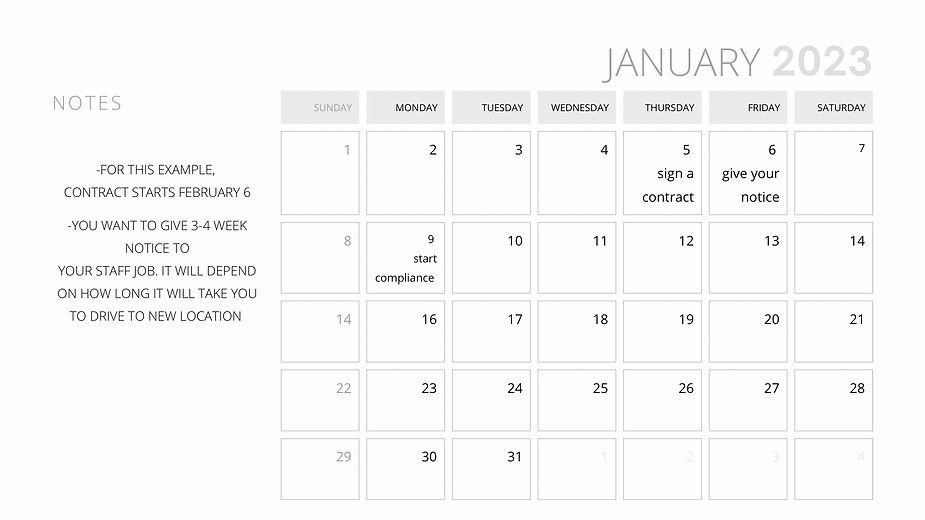
- Quitting your staff job, talking to recruiters,applying for contracts, and signing contracts… It seems like a lot! Get a calendar out and take a deep breath. Take a minute and take things one step at a time. I think you should start talking to recruiters a month and a half prior to actually looking for a start date. Start applying for an assignment a month early. For example, if you wanted to start on January 23, contracts are only starting to be posted December 23 or after. Holidays always delay things also! Check out my calendar for projected dates! Sometimes it can actually take a couple weeks to accept a travel nurse position. Compliance for a new contract can take approximately 3-4 weeks. It can take less time if it’s not with a new company. You need to submit your vaccination records, a tb test, drug screen, continuing education, and complete modules for the specific hospital. I remember my first contract, I applied to 30 contracts and I got overly involved in every position I applied for (Both my parents and my husband did too)! Travel nurses don’t receive calls back on every job. They get calls if you get an interview for a contract but don’t get a call for a decline. This was difficult as we would be excited to hear back from a job and would never hear back. It used to make me super anxious, but now we know the protocol. I’d suggest applying for a ton of different contracts with the hopes that one of them works out and you’d be happy with any of them. If you wouldn’t be happy with it, don’t bother applying.

- Find a good company and a supportive recruiter. You want to make sure you find a recruiter that’s willing to help you get what you want. Money is obviously great but it’s not everything. You want to make sure you negotiate weekends and have it in your contract (trust me you don’t want to work every weekend… you say it’s not a big deal, but it is). You want to make sure you know what you are getting into. Check out my upcoming blog about what to ask in a phone interview with a hospital. I really enjoy working with Aya and Cross Country. I also think it’s super important for a recruiter to be responsive. I don’t do well with someone that responds 24 hours later. I understand that I’m not the only one that’s trying to find a contract, but I also believe that a text message does not take a long time to answer. The recruiters are the individuals submitting you to possible assignments and it could make or break you possibly getting the assignment that you’re dreaming of. Side note, recruiters also make commission of your contract. Don’t base your opinion on the company based on one Recruiter. If you have one bad experience with one recruiter, find another recruiter and if it’s multiple recruiters, find another company. It’s good to shop around with different companies as some companies have better jobs out west and some companies have better jobs out east.
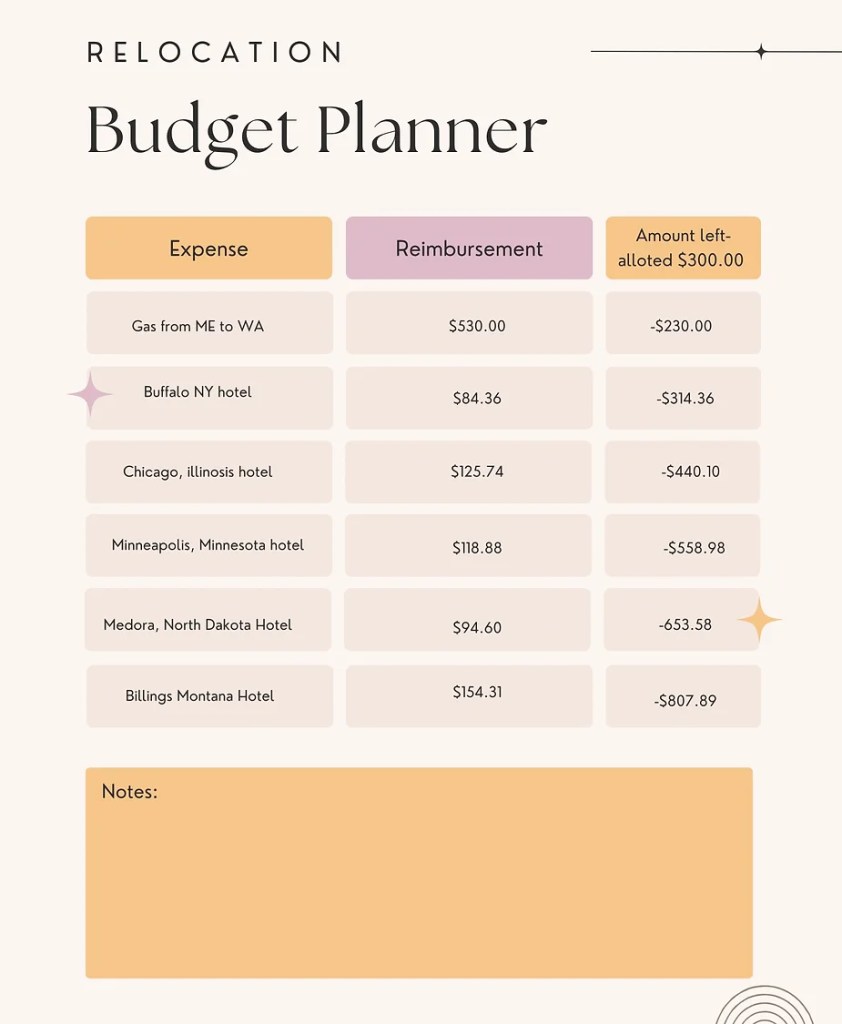
- Take a good look at your finances before you start travel nursing. It actually costs a lot to start out travel nursing even though you’re going to be making a lot more money. This also depends on where your first contract is. If your first contract is far away, the company does reimburse for relocation, but will not reimburse for your full relocation. For example, my first contract was 46 hours away from home. They reimbursed only $300, so that covered our gas money. The trip took us five days to get there and that’s five nights of hotels. Therefore, five nights of hotels we’re not paid for. You also have to start each contract with a new apartment or place to stay, so that’s the first month’s rent and security deposit that you need saved.Just like any new job, you aren’t paid the first two weeks of an assignment. The pros of doing a contract closer to home is that the reimbursement fee covers the entire reimbursement.
- Credentialing and getting lots of different licenses. Many people don’t know that people can’t practice in every state with one license. There’s something called a compact license and some states don’t fall under a compact license. Watch out for upcoming blog about how to apply for a non compact license. I suggest looking into getting as many different licenses for multiple states as possible, as it opens up opportunities for different jobs. I also suggest getting different credentials like ACLS AND NHISS. Having things like certified medsurg RN also makes you stick out to employers applying to the same job. Did you know that often companies like aya and cross country will reimburse you for these licenses and credentials? It’s a lot of work in terms of paperwork and fingerprinting, but it’s totally worth it! I have a compact state along with a Nevada, Oregon, Hawaii, Washington, and a pending Alaska and Minnesota license.
- Find reliable smart housing around your assignment. My husband and I do not do hotels but they work for some travelers. We typically look at furnished finders. Realistically think about how long you want your drive to be to work. This looks different for everyone in terms of what’s an acceptable drive. For me, I typically don’t want to drive any longer than 25 minutes. I know during my last assignment, I was supposed to be out at 7:30 PM, but I never got out before 9:00 PM. I couldn’t imagine driving longer than 15 minutes. Especially after a long day and I had to be back the next day for a 12 hour shift. Be smart in terms of how much money you give up front without seeing it first and read the lease terms thoroughly. Don’t agree to terms that you would not actually want to follow. I know this seems like common sense but sometimes you never know. Typically, my husband and I find furnished finders that we can sign month to month. Just in case things happen with the apartment or the assignment. It’s almost a sense of security. Most landlords accept month-to-month leases to travel nurses. Furnished finders and Craiglist are the main source of for travel nurses. We have also looked on Airbnb, but there’s a lot of fees with that. Sometimes you can talk to them individually and try to get out of the fees. Most landlords want the deposit before taking down the ad and securing the spot. Most landlords are accepting if you ask to see the spot in person/via FaceTime before sending the deposit. Some of them will allow you to show up the first day and then pay the deposit. I suggest looking it up on Google maps to make sure it coincides with what you are FaceTiming with. Most assignments start on Mondays. I really suggest trying to move in on Saturdays. My second contract was in North Carolina and we moved in on a Sunday and started Monday. It’s a lot to do in one day, along with grocery shopping and getting settled and unpacked. Our last assignment we moved in on Saturday and enjoyed Sunday in New York City and that felt less stressful when we started on Monday. Everyone has a different idea of what works for them. You learn after each assignment what works for you. , so you kind of learn what works for you. I’ve also learned it’s always worth asking. Money is hard to negotiate, but things like minimum day requirement, allowing pets, and even deposits are worth negotiating.
- When the hospital calls for an interview, this is your opportunity to interview them. Don’t feel like you can’t ask questions or they won’t hire you. I personally have a list of questions that I ask every hospital that calls for an interview. I think it’s important for the purpose of comparing apples to apples. This is particularly important when you get offered more than one contract and have to pick.
- Learn to be humble and understand that other people don’t understand travel nursing. Honestly… I’m still having a hard time with this. You will hear from family members, Uber drivers, friends, and random people that you make “buckets of money”. My first suggestion is to not discuss your pay with anyone besides your spouse. When someone asks about why travel nurses make that much money, I would explain duplicating expenses (paying rent twice, relocation every 13 weeks, bills, etc) and I would discuss the highs and lows of travel nursing. Check out my upcoming blog of the highs and lows of travel nursing. My second suggestion is when a staff member at another hospital mentions pay, don’t get defensive, instead say, “I have an awesome recruiter. Do you want her number? Travel has been great for my career and happiness. It’s been hard to be away from my family but it’s giving me the opportunity to see the world. Duplicating expenses is tough, but it’s so worth working at this great hospital and seeing the world”. Try not to get aggravated with the comment and move forward. I know sometimes it’s really difficult. People will also not understand why you are traveling vs being a staff member. People travel for all sorts of reasons. I started to travel because I was burntout and needed a change of scenery. I wanted to get this travel bug out of my system and it honestly may be making it worse. I’ve heard a few times from people that travel nurses are killing the hospital system. I’ve learned to ignore this comment and move forward. I know that I’m doing what’s best for myself and my husband. If the hospital did what was best for me in the first place, we wouldn’t have started travel nursing.
- I could go on for days about different tips and tricks about travel nursing, but lastly I’ll leave you with this… not everyone loves travel nursing. I don’t want you to feel like you have to love it and you can’t go back if you don’t like it. Everyone highlights the positives on social media, but no one actually puts the crappy negative stuff. At the end of the day, you just gotta do what makes you happy.
Are you gonna make that jump from staff nursing to travel nursing? Let me know how I can help you!
 TravelingbeebryantRN & Flicks_withNick
Leave a comment